

By Sean C. Orr, M.D.
12-Minute Read
Healthcare Reform Package Moving Through Tallahassee
We’re past the midpoint of the 2026 Regular Session, and the healthcare legislation moving through Tallahassee right now isn’t incremental. It’s structural. If you practice medicine in Florida, the bills advancing through committee this session have the potential to change who works alongside you, how your patients’ drugs are priced, whether new facilities can open in your market, and what your Medicaid reimbursement looks like in 2027 and beyond.
Here’s where things stand after Week 5.
The Big Bill: HG 693 – The “Big Beautiful Healthcare Frontier Act”
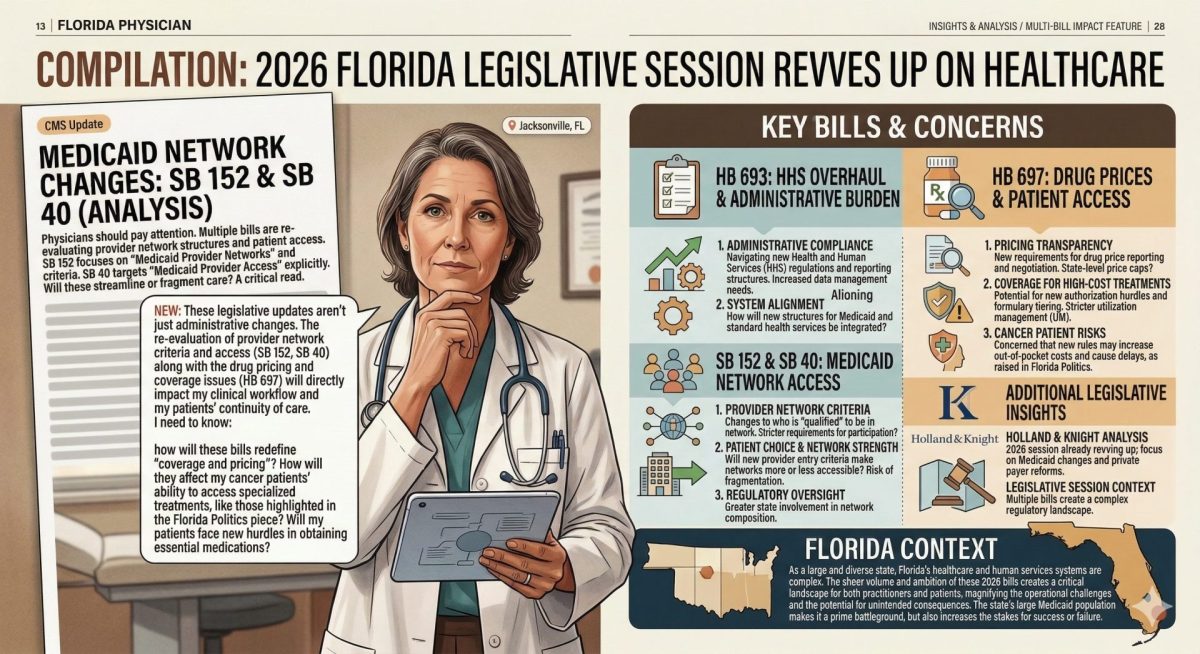
House Bill 693 is the centerpiece of Speaker Daniel Perez’s healthcare reform agenda, and it’s the most sweeping health policy bill Florida has seen in years. The House Health & Human Services Committee advanced it on January 29, and it’s now moving toward a Senate companion process that will likely produce significant amendments before crossover.
The bill touches nearly every structural element of healthcare delivery in this state. Here’s what matters most to your practice:
Scope of Practice Expansion
HB 693 authorizes autonomous practice for all five advanced practice registered nurse (APRN) specialties — not just primary care, where Florida granted limited independent practice authority several years ago. That means nurse anesthetists, nurse midwives, clinical nurse specialists, and psychiatric-mental health nurse practitioners could all practice without a physician supervisory agreement.
The bill also eliminates the cap on the number of physician assistants a single physician can supervise. Under current law, that cap has functioned as a structural bottleneck in high-volume practices and rural settings where PAs are essential to access. Removing it expands capacity — but also shifts supervisory liability dynamics that every physician employer needs to understand.
Additionally, Florida would join interstate licensure compacts for physician assistants and emergency medical services workers, making it easier for out-of-state providers to practice here.
What this means for you: If you’re a physician who has built your practice model around supervisory relationships with APRNs or PAs, the economic and medicolegal landscape is about to shift. Autonomous APRN practice means those practitioners become potential competitors, not just colleagues. At the same time, eliminating PA supervision caps could let you scale your existing team. The strategic question is whether you lead this transition or react to it.
Certificate of Need Elimination
HB 693 proposes a full repeal of Florida’s remaining Certificate of Need (CON) requirements — the regulatory process that currently restricts the addition of nursing homes, hospice providers, and intermediate care facilities for individuals with developmental disabilities.
CON has been a fixture of Florida healthcare regulation for decades, and its defenders argue it prevents oversaturation and protects quality. Its critics — and this bill’s sponsors are clearly among them — argue it protects incumbent operators from competition and restricts patient access.
What this means for you: If you refer patients to post-acute or hospice care, eliminating CON could expand your referral options and reduce wait times. If you have financial interests in facilities that currently benefit from CON protections, this is a material threat to your market position. Either way, it’s a fundamental change to the competitive landscape.
Medicaid Alignment With Federal Changes
HB 693 codifies in state statute several provisions from the federal “One Big Beautiful Bill Act” passed by Congress in July 2025. For Medicaid, the key changes include reducing retroactive coverage from three months to two months, codifying federal prohibitions on Medicaid payments to certain barred entities, and tightening eligibility criteria for certain immigrant populations.
What this means for you: If your practice serves a significant Medicaid population, the retroactive coverage reduction means you’ll have a narrower window to bill for services rendered before a patient’s enrollment was confirmed. That’s a revenue cycle issue your billing team needs to prepare for now.
The Drug Pricing Bill: HB 697 – The PRICE Act
House Bill 697 is the companion piece that could fundamentally change how prescription drugs are priced across every payer in Florida. The bill creates the Prescription Reduction Incentives and Competition Enhancement (PRICE) Act, and its core mechanism is international reference pricing — the same most-favored-nation concept driving the federal GENEROUS, GLOBE, and GUARD models, but implemented at the state level.
Here’s how it works: The Agency for Health Care Administration (AHCA) would establish a most-favored-nation upper payment limit for prescription drugs by identifying the lowest net price accepted by manufacturers in countries with similar economic profiles and market-based healthcare systems. Commercial insurers, HMOs, Medicaid managed care plans, and the State Group Health Insurance Program would then be required to pay no more than those reference prices.
The bill also takes aim at pharmacy benefit managers (PBMs) — the opaque intermediaries that sit between drug manufacturers, pharmacies, and patients. HB 697 would prohibit certain formulary practices, including mid-year formulary changes that disrupt patient access to medications they’re already taking. The “frozen formulary” provision is a direct response to the widespread practice of PBMs pulling drugs from coverage mid-cycle, forcing patients and their physicians into destabilizing therapeutic switches
What this means for you: If HB 697 becomes law, the drugs you prescribe could be subject to a state-level price ceiling benchmarked to international markets. For most physicians, this is a positive development — lower drug costs reduce prior authorization friction, expand formulary access, and improve adherence. But if you administer high-cost therapeutics in your office and rely on buy-and-bill revenue, the pricing dynamics require attention. The frozen formulary provision is an unambiguous win for physician prescribing autonomy and patient continuity.
Medicaid Access Bills Worth Watching
Two Senate bills are advancing through committee that address a chronic pain point for Florida physicians who treat Medicaid patients:
SB 152 would require Medicaid managed care plans and providers to negotiate mutually acceptable rates, methods, and terms of payment for reimbursement. It also mandates that plans accept prior authorization requests electronically — a seemingly small provision that eliminates the fax-and-phone gauntlet that costs your staff hours every week. The bill additionally establishes specific reimbursement floors for dental providers.
SB 40 would require at least 50 percent of primary care providers in a Medicaid managed care network to offer appointment availability outside of regular business hours and on state holidays. This is aimed at reducing emergency department utilization among Medicaid enrollees, but it creates a staffing and scheduling mandate that primary care practices need to plan around.
What this means for you: SB 152’s electronic prior authorization mandate is long overdue and would meaningfully reduce administrative burden. The negotiated-rate provision could provide leverage against Medicaid MCOs that have historically dictated terms unilaterally. SB 40 is more complex — extending hours improves access, but the cost falls on your practice unless reimbursement adjusts accordingly. Watch for amendments that address the compensation side of this mandate.
The Physician Leadership Litmus Test
This is where we step back from the policy details and ask the question that defines Florida Doctor Magazine’s editorial lens: Does this legislative agenda advance physician leadership, or does it erode it?
The honest answer is that it does both — and the balance depends entirely on whether Florida’s physician community engages now or sits this one out.
Where it advances physician leadership:
The drug pricing reforms in HB 697 address a structural problem that has undermined physician prescribing autonomy for decades. When a PBM can pull a medication from formulary mid-year, or when a drug that’s clinically indicated is cost-prohibitive under Medicaid, the physician isn’t practicing medicine, they’re navigating a pricing bureaucracy. International reference pricing and frozen formularies have the potential to restore clinical decision-making authority to the exam room.
The Medicaid access provisions in SB 152 and SB 40, while imperfect, signal a legislative recognition that the current managed care system hasn’t delivered on its promise of adequate provider reimbursement or patient access. Electronic prior authorization alone could reclaim thousands of staff hours across Florida practices.
Where it threatens physician leadership:
The scope of practice expansions in HB 693 represent the most significant erosion of the physician-led care model in Florida since the original APRN autonomous practice legislation. Extending independent practice authority to all APRN specialties — including nurse anesthetists and psychiatric nurse practitioners — without a corresponding framework for quality oversight or collaborative practice standards is a workforce policy disguised as a deregulation initiative.
Eliminating PA supervision caps without updating the liability framework creates ambiguity that will be resolved in courtrooms, not clinics. And joining interstate licensure compacts without ensuring that out-of-state providers meet Florida’s standards could dilute the quality infrastructure that the state’s medical community has built over decades.
The bottom line:
This legislative package contains provisions that could genuinely improve patient access, lower costs, and reduce administrative burden — all things physicians have been demanding for years. But it also contains provisions that expand the practice authority of non-physician providers without meaningful physician input into the implementation framework.
Florida’s physicians can’t afford to cherry-pick the provisions they like and ignore the ones they don’t. The session ends March 13. The window to shape these bills is measured in days, not months.
What Florida Physicians Should Do Right Now
- Read the bills. HB 693 and HB 697 are both available on the [Florida Senate website](https://www.flsenate.gov/Session/Bills/2026). Don’t rely on summaries, not even this one. The details in committee amendments matter.
- Contact your state senator. The House has already acted on HB 693. The Senate companion process is where amendments happen. If you have concerns about scope of practice, CON elimination, or Medicaid coverage changes, your senator’s office needs to hear from you — as a physician, not as an interest group.
- Engage the FMA. The Florida Medical Association should be your primary advocacy vehicle during session. If you’re not currently active in the FMA’s legislative affairs committee, now is the time. If you are, push for a coherent physician-community response that addresses both the opportunities and the threats in this package.
- Brief your practice team. The Medicaid retroactive coverage change, the electronic prior authorization mandate, and the PA supervision cap removal all have direct operational implications. Your billing, compliance, and HR teams should be planning for these changes now, not after the Governor signs the bill.
- Talk to your patients. The drug pricing provisions in HB 697 could meaningfully reduce out-of-pocket costs for your patients. The Medicaid access provisions in SB 40 and SB 152 could improve their experience navigating the system. They deserve to know what’s happening in Tallahassee — and that their physician is paying attention.
Florida Doctor Magazine covers the regulatory, financial, and clinical issues shaping physician practice in the Sunshine State. Subscribe to our weekly newsletter for expert-level analysis delivered free to your inbox.
floridadoctormagazine.com/subscribe
Sources
- Florida House HB 693 — Health and Human. Services (https://www.flhouse.gov/Sections/Bills/billsdetail.aspx?BillId=83322&SessionId=113)
- Florida Senate HB 693 — Bill Analysis. (https://www.flsenate.gov/Session/Bill/2026/693)
- Florida House HB 697 — Drug Prices and Coverage. (https://www.flhouse.gov/Sections/Bills/billsdetail.aspx?BillId=83324&SessionId=113)
- Florida Senate SB 152 — Medicaid Provider Networks. (https://www.flsenate.gov/Session/Bill/2026/152)
- Florida Senate SB 40 — Medicaid Provider Access.(https://www.flsenate.gov/Session/Bill/2026/40)
- Holland & Knight: The 2026 Florida Legislative Session Is Already Revving Up.(https://www.hklaw.com/en/insights/publications/2025/10/the-2026-florida-legislative-session-is-already-revving-up)
- Florida Politics: Cancer Patients and HB 697 Concerns.(https://floridapolitics.com/archives/776329-michelle-flowers-floridas-cancer-patients-cant-afford-the-risks-of-hb-697/)
Frequently Asked Questions
What healthcare bills are in the Florida 2026 legislative session?
The Florida 2026 legislative session Week 5 includes bills addressing scope of practice changes, telehealth expansion, medical malpractice reform, and physician workforce development programs.
How will 2026 Florida legislation affect physician practices?
Key bills in the 2026 session could reshape physician scope of practice, modify malpractice liability standards, expand telehealth reimbursement, and create new workforce pipeline programs for Florida doctors.
When is the Florida 2026 legislative session?
The Florida 2026 legislative session runs from January through March 2026, with healthcare committees actively advancing bills through Week 5 and beyond.