
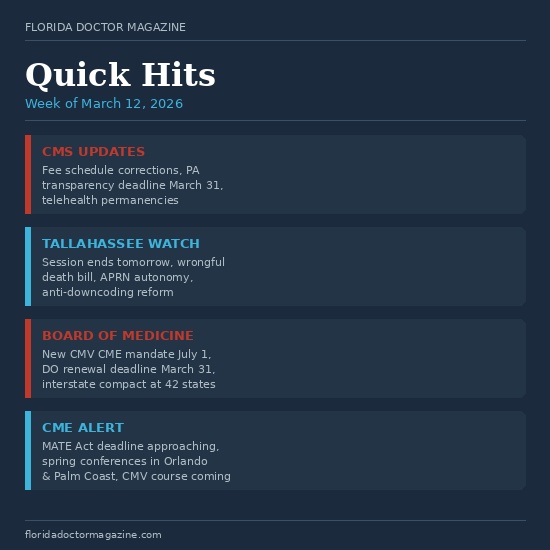

Welcome to this week’s Quick Hits — your concise roundup of the regulatory, legislative, and clinical education developments that matter most to Florida physicians. Four sections, one read, everything you need to stay current.
1. CMS Updates
Physician Fee Schedule Correction Notice — March 12, 2026
CMS published a Federal Register correction notice today (CMS-1832-F) addressing technical and typographical errors in the CY 2026 Medicare Physician Fee Schedule Final Rule. The correction updates practice expense relative value units (RVUs) for 10 specific CPT codes, primarily affecting radiation oncology (77402, 77407, 77412, 77436, 77437, 77438) and remote patient monitoring (99445, 99454, 98977, 98985).
What to do: If your practice bills for radiation therapy delivery or remote monitoring services, verify the updated RVU values in your billing systems now. The corrections align reimbursement with the finalized OPPS APC payment rates.
Prior Authorization Transparency Deadline — March 31, 2026
The first mandatory reporting deadline under the CMS Interoperability and Prior Authorization Final Rule (CMS-0057-F) hits at month’s end. All impacted payers — Medicare Advantage organizations, Medicaid managed care plans, and QHP issuers — must post aggregated prior authorization metrics for calendar year 2025 on their public websites by March 31, 2026.
This means you’ll soon have unprecedented visibility into denial rates, decision timeframes, and appeal outcomes for every plan serving your patients. The rule also enforces 72-hour turnaround for expedited requests and 7 calendar days for standard requests, with mandatory written denial explanations. If you’ve been fighting prior authorization delays, this is the structural change you’ve been waiting for. Our analysis of how insurance structures reshape physician control provides the deeper context behind this reform.
Telehealth Policy Clarifications
CMS released an updated Telehealth FAQ (February 26, 2026) confirming several permanent policy changes effective January 1, 2026. Key permanencies include: direct supervision no longer requires physical presence (it can be provided via real-time audiovisual telecom), and teaching physicians can now be virtually present when the underlying service is furnished virtually. Audio-only telehealth continues through December 31, 2027, and DEA has extended controlled substance telemedicine prescribing flexibilities through December 31, 2026.
One restriction: Physical therapists, occupational therapists, speech-language pathologists, and audiologists can no longer furnish Medicare telehealth services effective January 31, 2026. If your practice employs rehabilitation therapists, update billing protocols accordingly.
2. Tallahassee Watch
Session Wraps Tomorrow — Budget Unfinished
Florida’s 60-day legislative session is scheduled to conclude March 13, 2026 — tomorrow — but leadership has acknowledged the budget will not be completed by adjournment. A special session extension is expected. Here’s where the healthcare bills that matter most to physicians stand:
Wrongful Death for Unborn Children — HB 289 / SB 164
This bill establishes civil liability allowing parents to sue for wrongful death of an unborn child at any stage of pregnancy. It advanced through committee and carries an effective date of July 1, 2026. While the bill includes a provision stating liability cannot attach for “lawful medical care provided in compliance with applicable standard of care,” the malpractice exposure for OB-GYNs and maternal-fetal medicine specialists is significant. If you practice in these areas, the malpractice insurance landscape may shift meaningfully if this passes.
Psychiatric APRN Autonomy — HB 301 / SB 138
This scope of practice bill authorizes APRNs with psychiatric mental health certification to practice autonomously — without physician supervision or protocol — in psychiatric services. Approximately 5,679 APRNs hold psychiatric certifications and could become eligible. Effective date: July 1, 2026. This follows the broader national trend of NP independence that Florida has been gradually adopting. Physicians in psychiatry and collaborative mental health settings should watch this closely.
Anti-Downcoding / PA Reform — SB 1130
A bright spot for physicians: SB 1130 prohibits payment adjudicators from downcoding healthcare services under certain circumstances and requires utilization review entities to use standardized prior authorization forms. Combined with the CMS transparency deadline above, the prior authorization landscape is shifting — slowly — in physicians’ favor.
Naturopathic Licensure — HB 223 / SB 688
Florida may reestablish naturopathic physician licensure (abolished in 1959) with a new Board of Naturopathic Medicine under the Department of Health. The scope explicitly excludes prescribing legend drugs and surgical procedures, limiting direct competition. But the creation of a new licensed provider category is worth monitoring.
For broader legislative context, our Week 5 session analysis covers additional bills reshaping physician practice.
 CMS Updates, Tallahassee Watch, Board of Medicine, CME Alert" style="max-width:550px; width:100%; height:auto; border-radius:8px;" />
3. Board of Medicine
New CME Mandate: Congenital CMV — Effective July 1, 2026
The Florida Board of Medicine is implementing a new mandatory 1-hour CME requirement on congenital cytomegalovirus (CMV), effective July 1, 2026. This applies to all allopathic and osteopathic physicians and must be completed as part of licensure renewal and at every other biennial renewal cycle thereafter.
This is a net addition to your existing CME load. If you’re planning your CME strategy for the next renewal cycle, add this to the mandatory checklist alongside medical errors, controlled substances, and domestic violence. Our complete CME requirements guide will be updated to reflect this new mandate.
DO License Renewal Deadline — March 31, 2026
Osteopathic physicians with licenses issued between April 1, 2024 and March 31, 2026 face an expiration date of March 31, 2026. If this is your cycle, ensure all CME hours — including mandatory topics — are completed and your renewal application is submitted before the deadline. A lapsed license carries consequences beyond fees; your malpractice coverage may be affected.
Full Board Meeting — March 26, 2026
The Florida Board of Medicine meets March 26 at 8:00 AM EDT via telephone conference. The agenda will include disciplinary cases, licensure approvals, and policy discussions. Contact the Board office at 850-245-4131 or visit flboardofmedicine.gov for details.
Interstate Compact Update
Florida remains active in the Interstate Medical Licensure Compact, which now includes 42 states plus D.C. and Guam. If you’re considering practicing across state lines or recruiting out-of-state physicians, the MOBILE Act changes have also reduced the active practice requirement from 3 years to 2 years, making Florida more competitive for physician recruitment.
4. CME Alert
MATE Act: Check Your DEA Renewal Date
If your DEA registration expires in 2026, you must complete 8 hours of MATE Act training (Mainstreaming Addiction Treatment) on opioid and substance use disorders before your renewal date. This is a one-time federal requirement for all DEA-registered practitioners. Free training is available from the Grayken Center at Boston Medical Center, among other ACCME-accredited providers. Don’t wait — DEA renewal processing times have increased, and last-minute completion creates unnecessary risk to your prescribing authority.
Spring CME Conferences in Florida
If you prefer earning credits at in-person events, several accredited conferences are coming up:
March 29–31: Cardiology and Pain Management for Primary Care at Disney’s Grand Floridian, Orlando — 12 AMA PRA Category 1 Credits.
March 30 – April 3: Multi-specialty conference at Hammock Beach Resort, Palm Coast — 20 CME credits plus a bonus 15-credit online course for in-person attendees.
Additional spring dates: Beachfront CME events in St. Pete Beach, Clearwater, and Sarasota offering 12–20 credits per event. Check our guide to maximizing CME opportunities before you commit.
Reminder: Congenital CMV Course Coming
As noted in the Board of Medicine section above, the new 1-hour congenital CMV requirement takes effect July 1, 2026. Accredited courses should be available from Board-approved providers by late spring. We’ll update our CME requirements guide with specific course links as they become available.
Frequently Asked Questions
How do I check if the CMS fee schedule corrections affect my billing?
Review the Federal Register notice (CMS-1832-F, published March 12, 2026) for the specific CPT codes and updated RVU values. If your practice bills for radiation oncology codes (77402–77438) or remote patient monitoring codes (99445, 99454, 98977, 98985), verify that your practice management software reflects the corrected values. Your billing department or clearinghouse should be able to confirm.
When does the congenital CMV CME requirement start?
The 1-hour Board-approved CME course on congenital CMV becomes mandatory effective July 1, 2026. It must be completed as part of your licensure renewal and at every other biennial renewal cycle thereafter. This applies to both MDs and DOs in Florida.
Is the MATE Act training a one-time or recurring requirement?
The MATE Act 8-hour training is a one-time federal requirement. Once completed, you do not need to repeat it for subsequent DEA renewals. However, you must complete it before your first DEA renewal after June 27, 2023. If your DEA registration expires in 2026 and you haven’t completed it yet, prioritize this now.
Florida CME Requirements 2026: Complete Guide for MDs and DOs
Physician Burnout in 2026: Why Florida Doctors Are Talking About Moral Injury
Florida’s 2026 Legislative Session: Week 5
When Control Leaves the Operating Room
Florida Medical Malpractice Insurance in 2026
10 Tips to Make the Most of CME Opportunities
Stay ahead of the changes that shape your practice.
Subscribe to Florida Doctor Magazine for weekly Quick Hits and deep dives on everything that matters to Florida physicians.