

By Sean Orr, M.D. | July 6, 2026 | Florida Doctor Magazine
Dr. Elisabeth Potter was elbow-deep in a breast reconstruction when UnitedHealthcare called the operating room. Not about an emergency. Not about a complication. They wanted to know why her patient, who was under anesthesia on the table, needed to stay overnight after cancer surgery.
The representative didn’t even know the patient had breast cancer. “That’s a different department,” the rep told her.
That call, which Potter recorded and posted to TikTok in January 2025, has now been viewed nearly six million times. It turned a plastic surgeon from Austin, Texas into one of the most visible physician voices in the country on insurance overreach. And on May 21, she brought that same fight to the steps of the U.S. Capitol.
What Happened at the Rally
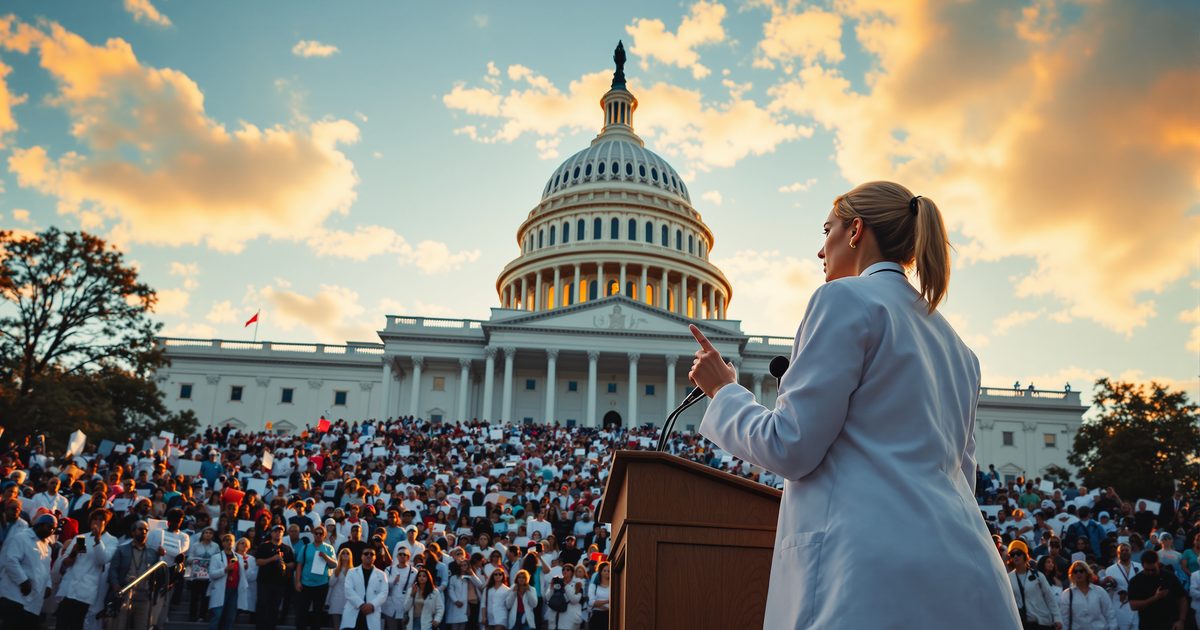
Potter joined more than 400 healthcare workers, bipartisan lawmakers, and actor Noah Wyle at the “Healthcare is Human” rally outside Congress. The event brought together Sen. Tim Kaine (D-VA), Sen. Bernie Sanders (I-VT), Rep. Claudia Tenney (R-NY), Rep. Steven Horsford (D-NV), and Rep. Buddy Carter (R-GA). That level of bipartisan alignment should tell you something about how deep this problem runs.
Potter spoke about her ongoing battle with UnitedHealthcare. After posting the viral video, she received a letter from a defamation law firm retained by the insurer, alleging she’d made false claims. She published the letter. She threatened an anti-SLAPP suit.
Then things got worse. UnitedHealthcare has refused to bring her surgery center, the RedBud Surgery Center in Austin, into its provider network. Potter says the decision amounts to economic retaliation. She told NBC News she’s $5 million in debt. Her husband cashed out his 401(k) to keep the lights on. She’s not drawing a salary.
UnitedHealthcare says the network was closed to new centers in October 2024, before Potter’s viral post. Potter says communications with her consultant continued through January 2025, right up until the video went live.
If any of this sounds familiar, it should. We covered the broader wave of public backlash against UnitedHealth earlier this year, when the company was facing DOJ investigations, executive departures, and a social media reckoning that showed no signs of slowing down. Potter’s Capitol Hill appearance is the next chapter of that same story.
Why This Matters for Florida Physicians
Florida physicians don’t need a TikTok video to understand what Potter is describing. Sixty-six of the state’s 67 counties report at least partial primary care shortages. The average search for a permanent primary care physician here now exceeds seven months. UnitedHealthcare is the second largest insurer in Texas, and it’s a dominant player in Florida too, where it controls a massive share of Medicare Advantage enrollment.
The dynamic Potter describes, where a single insurer controls whether a physician practice survives through network inclusion or exclusion, plays out in Florida every day. Layer that on top of the private equity consolidation wave already squeezing independent practices across the state, and you start to see a pattern: the physicians who push back are the ones who pay the steepest price. Most doctors who face it don’t have six million TikTok viewers backing them up.
A 2021 KFF analysis found that insurers denied an average of 17% of in-network claims. Not out-of-network. In-network. Physicians who had contracts, who followed the rules, who ground through the regulatory paperwork that already consumes a third of their workday. They still got denied one out of every six times.
The rally also spotlighted three pieces of legislation that deserve Florida physicians’ attention.
The first is the Healthcare is Human Act (H.R. 7884), introduced by Tenney and Horsford in March 2026, which would create a tax credit of up to $6,000 per year for healthcare professionals serving in federally designated shortage areas. To qualify, providers must earn under $200,000 annually and work at least 80 hours per month for eight months in a qualifying facility. Given Florida’s 66-county shortage crisis, a large number of the state’s physicians would be eligible.
The second is the reauthorization of the Dr. Lorna Breen Health Care Provider Protection Act, signed into law in February 2026, which allocates $45 million annually through 2029 for mental health programs targeting healthcare workers. Named after the New York City emergency physician who died by suicide during the early months of COVID-19, the law funds peer-support programs and training to reduce the stigma around seeking help, a stigma that still runs thick in medicine. We wrote about how post-shift rumination quietly erodes physician wellbeing even outside the hospital. The Breen Act is one of the few federal responses that acknowledges this isn’t just a personal resilience problem.
The third is a push for whistleblower protections for healthcare workers who raise concerns about patient safety or workplace conditions without fear of employer retaliation.
What Florida Physicians Should Do Now
- Know the bills by name. The Healthcare is Human Act (H.R. 7884) and the Dr. Lorna Breen Reauthorization are both live in the 119th Congress. Contact your U.S. Representative and ask where they stand. Florida has 28 House seats. That’s 28 votes that could move this forward.
- Document every payer denial. If you’re fighting claim denials or network exclusion decisions that feel retaliatory or arbitrary, keep records. The Florida Medical Association tracks these patterns, and documented cases build the evidentiary foundation for state-level reform.
- Check your shortage-area eligibility. If you practice in one of Florida’s 66 designated shortage counties, the Healthcare is Human Act’s $6,000 annual tax credit could apply to you. The bill isn’t law yet, but knowing your eligibility status now means you’re ready to act the moment it passes.
- Talk about this openly. Potter’s power comes from the fact that she said out loud what most physicians only say behind closed doors. The insurer playbook depends on physician silence. Break the pattern. Share this article with your partners, your medical staff, your county medical society.
- Look at physician-led organizations building infrastructure around autonomy. The Atlas Accord is one worth knowing about: a strategic alliance of physicians dedicated to defending independence and rebuilding the profession from within, not from the outside. When the professional organizations are slow to move, physician-to-physician networks like this fill the gap.
The Bigger Picture
Potter didn’t set out to become an activist. She set out to perform breast cancer reconstructions in a surgery center she built with $3.5 million in personal loans. She jumped through every certification hoop, met every safety standard, and then discovered that none of that mattered if the insurer decided the answer was no.
The fact that a story this specific (one surgeon, one insurer, one phone call) resonated with six million people tells you everything about where American medicine stands right now. The frustration isn’t theoretical. It’s not partisan. It’s the lived experience of physicians who went into medicine to care for patients and found themselves instead negotiating with bureaucrats who don’t know their patient has cancer.
The rally at the Capitol was a start. But rallies don’t change policy. Bills do. And bills move when physicians, organized and documented and unwilling to be silent, make it impossible for legislators to look away. That’s why alliances like The Atlas Accord matter: they give independent physicians a collective voice and the structural backing to use it without risking their livelihood alone.
Frequently Asked Questions
What is the Healthcare is Human Act, and does it affect Florida physicians?
The Healthcare is Human Act (H.R. 7884) is a bipartisan bill that would create a tax credit of up to $6,000 per year for healthcare professionals working in federally designated shortage areas. Since 66 of Florida’s 67 counties report at least partial primary care shortages, a large number of the state’s physicians could qualify if the bill becomes law.
Why did Dr. Elisabeth Potter’s UnitedHealthcare video go viral?
In January 2025, Potter posted a TikTok video describing how UnitedHealthcare called her operating room mid-surgery to question whether her breast cancer patient needed an overnight hospital stay. The representative didn’t know the patient had cancer. The video struck a nerve with patients and healthcare workers frustrated by insurance interference in clinical decisions, reaching nearly six million views.
What is the Dr. Lorna Breen Health Care Provider Protection Act?
Named after an NYC emergency physician who died by suicide during COVID-19, this federal law funds mental health programs and peer-support services for healthcare workers. It was reauthorized in February 2026 with $45 million in annual funding through 2029. The law aims to reduce stigma around mental health treatment in the medical profession.
Can Florida physicians face retaliation from insurers for speaking out?
There are currently no federal protections specifically shielding physicians from insurer retaliation for public criticism. Potter’s case illustrates the risk: she alleges UnitedHealthcare blocked her surgery center from joining its network after her viral posts. Proposed whistleblower legislation discussed at the May 2026 rally aims to address this gap, but it has not yet been enacted.
How can Florida physicians get involved in healthcare policy advocacy?
Contact your U.S. Representative about the Healthcare is Human Act (H.R. 7884), document payer denial patterns through the Florida Medical Association, and engage with your county medical society. The FMA tracks legislative priorities and coordinates physician testimony for both state and federal hearings.
Hero image: illustration created with AI image tools.