

Skip to Main Content
Insurance Overreach in Surgery. Dark clinical operating room environment with ghosted insurance denial text, a faint DENIED stamp, EKG pulse line, and three icons representing surgical tools, insurance denial, and financial documents. Florida Doctor Magazine branding at bottom.
Insurance bureaucracy is reaching past the waiting room and into the operating room itself. Illustration by Florida Doctor Magazine.

When Control Leaves the Operating Room: How Insurance Is Reshaping Medicine From the Inside

By Mackenzie Keller

3-Minute Read

Insurance Overreach in Surgery


In a recent YouTube Short, Dr. Elisabeth Potter, MD, a board-certified plastic surgeon and DIEP specialist known for her work in breast reconstruction, describes a moment that stopped her in her tracks. One of her patients had already been placed under general anesthesia for surgery before Dr. Potter had even seen or marked the patient herself.

For surgeons, this is not a minor procedural detail. Pre-operative marking is a critical safety step. It is how surgeons confirm anatomy, finalize surgical plans, and ensure alignment between clinical judgment and operative execution. The fact that a patient was anesthetized before that process occurred reflects something far deeper than a scheduling miscommunication. It reflects a system where operational and insurance-driven constraints increasingly override physician control inside their own facilities.

This video is not about a single isolated incident. It is about what happens when doctors no longer have full authority over how and where their patients receive care.

Insurance Overreach in Surgery​. An infographic titled "When Control Leaves the Operating Room," illustrating how insurance and corporate interests interfere with medical practice. The image features a large fist labeled "Corporate Interests" grasping a stethoscope from a doctor, with documents marked "Prior Auth Denied" and "Coverage Limit." It includes various sections on data overrides, clinical autonomy loss, and corporate pressure, as well as several smaller images on legal, pharmaceutical, and other professional themes. The bottom left features the "Florida Doctor" logo with the text "Better Care · Better Practice · Better Life."


From Viral Video to National Conversation on Insurance Overreach

Dr. Potter first came into the national spotlight in January 2025 after publicly sharing an experience involving insurance interference during a surgical case. Since then, she has become an outspoken advocate for physician autonomy and patient safety, consistently highlighting how insurance structures influence clinical decision-making in ways that most patients never see.

Her recent video underscores a growing concern among physicians across specialties. Insurance contracts often dictate where a patient can receive care, which facilities are considered in network, and which operational models are financially viable. In many cases, surgeons must operate within systems designed around reimbursement rules rather than clinical best practices.

That dynamic can leave physicians feeling like guests in their own operating rooms.


How Insurance Network Restrictions Override Surgeon Authority

When insurance networks restrict where patients can be treated, doctors may be forced to work in facilities that are not their preferred or primary practice environments. Administrative protocols may be shaped more by payer requirements than by surgeon workflow. Safety checks that were once second nature can be compressed, rushed, or sequenced differently because of institutional pressures tied to coverage and reimbursement.

Physicians across the country describe a growing sense of lost autonomy. They are trained to take ultimate responsibility for their patients, yet key decisions about timing, location, approvals, and even staffing are increasingly influenced by insurance structures. If they push back too forcefully, they risk contract disputes, network exclusion, or financial strain on their practices.

The result is a quiet but profound tension inside modern medicine. Doctors remain legally and ethically responsible for patient outcomes, yet they do not always control the systems in which those outcomes unfold.


What Patients Don’t See… And Can’t Afford to Ignore


For patients, the consequences are often invisible. They may not realize that their surgeon did not choose the facility freely. They may not understand that certain operational shortcuts are symptoms of systemic constraints rather than individual negligence. They assume their doctor is fully in charge.

Increasingly, that assumption is not entirely true.


When Payer-Driven Healthcare Becomes a Patient Safety Issue

Dr. Potter has been vocal about this imbalance. She has argued that insurance overreach does not only burden physicians with paperwork and prior authorizations. It alters the physical and operational landscape of care. It can shape where surgeries occur, how teams are structured, and what processes are prioritized. When those pressures intersect with high-stakes procedures performed under general anesthesia, the loss of autonomy becomes more than administrative. It becomes a patient safety issue.

Her advocacy resonates because many physicians share the same concerns but feel unable to speak openly. Contracts and corporate healthcare structures often discourage public criticism. Doctors worry about retaliation or reputational harm. As a result, much of this frustration remains behind closed doors.


Why Dr. Potter’s Voice Matters for Physician Autonomy

What makes Dr. Potter’s voice significant is not only her specialty expertise in complex breast reconstruction but her willingness to publicly articulate what many clinicians privately feel. The issue is not about one insurance company or one facility. It is about a broader system where financial gatekeeping increasingly intersects with clinical authority.

When a surgeon walks into an operating room, the expectation is clear. The physician leads. The team follows clinical judgment. Safety protocols are surgeon-directed. If that chain of authority becomes diluted by external pressures, the foundation of trust between doctor and patient begins to shift.


Who Is Truly in Control of Patient Care?

The question raised by her video is simple but urgent. Who is truly in control of patient care?

Until physicians regain meaningful autonomy in where and how they practice, these moments will continue to surface. And each one forces the medical community to confront an uncomfortable reality. Insurance structures are not just influencing healthcare from the outside. They are shaping it from within the operating room itself.


Florida Doctor Magazine covers the regulatory, financial, and clinical issues shaping physician practice in the Sunshine State. Subscribe to our weekly newsletter for expert-level analysis delivered free to your inbox.

floridadoctormagazine.com/subscribe

Frequently Asked Questions

How is insurance reshaping medicine in Florida?

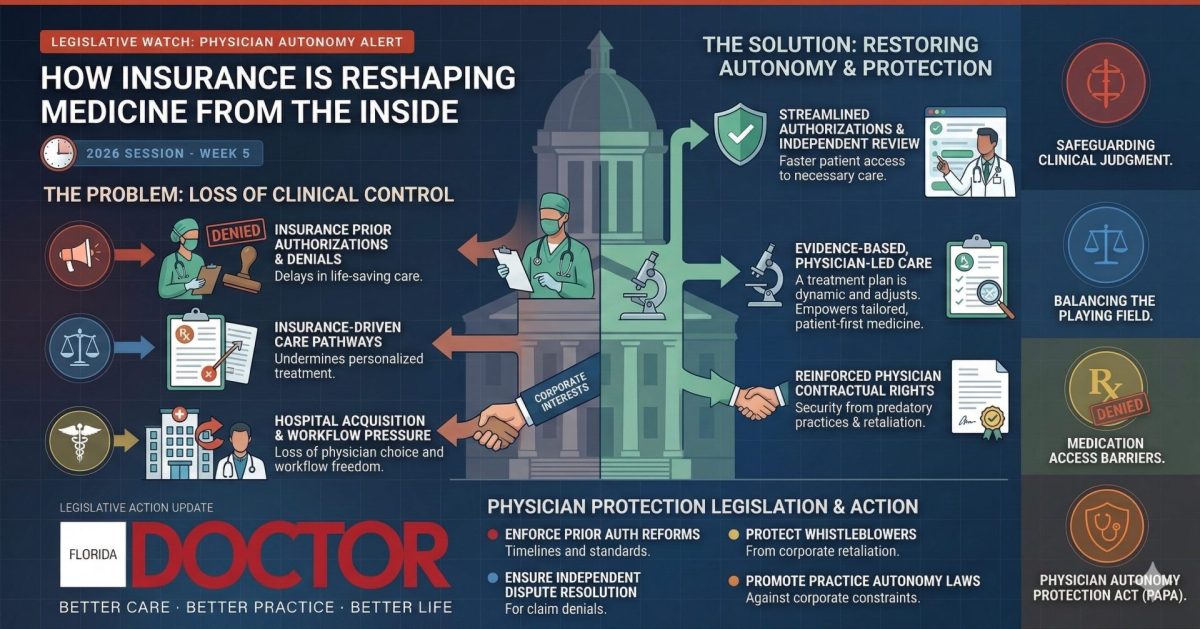
Insurance companies are increasingly dictating treatment decisions, limiting physician autonomy in the operating room, and using prior authorization requirements that delay patient care across Florida medical practices.

What can Florida physicians do about insurance overreach?

Florida physicians can join advocacy organizations, document prior authorization delays, support legislative reform efforts in Tallahassee, and participate in collective negotiations with insurers.

How does prior authorization affect patient outcomes?

Prior authorization requirements can delay critical treatments by days or weeks, leading to worsened patient conditions, increased emergency visits, and higher overall healthcare costs in Florida.