
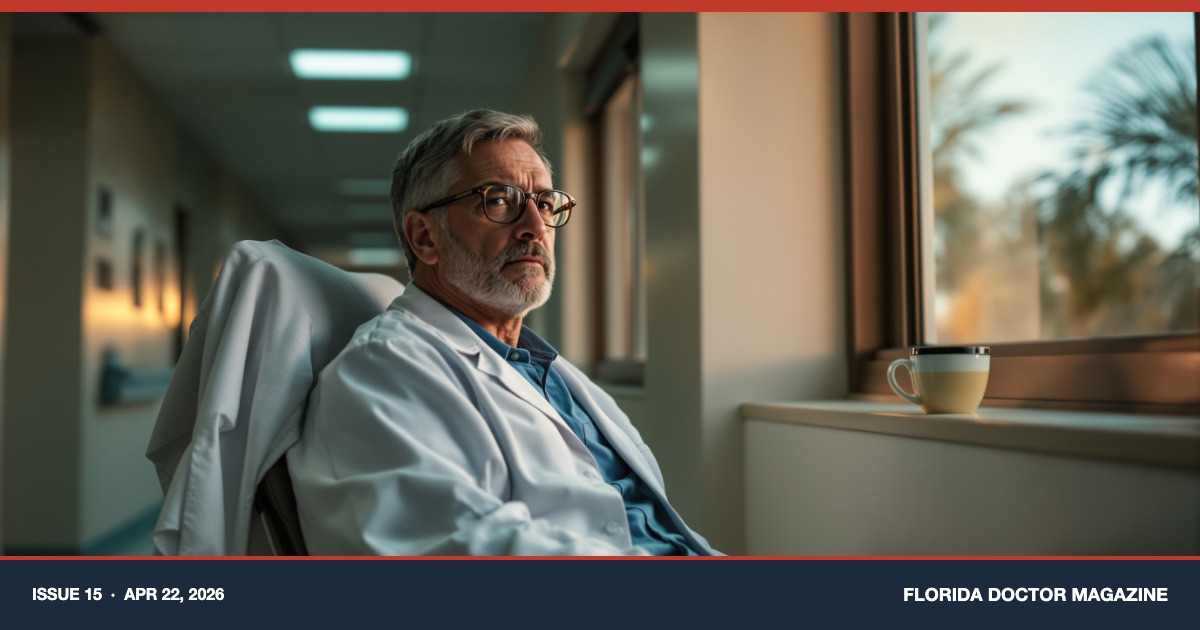

A Jacksonville family physician, fifteen years out of residency, told me last month that she no longer knows who her mentor is. She had four of them in training. She had two as a junior attending. Now, at 43, with a full panel, two kids in middle school, a dying parent across the state, and a reputation that means she gets asked to chair committees, she cannot name a single person whose job it is to watch out for her professional development.
That is the mid-career physician problem, and it is everywhere.
The Literature Finally Caught Up
Most of the physician wellbeing research that got funded between 2015 and 2022 focused on residents, fellows, and junior attendings. That is the population where burnout was first measured reliably, and it is also the population most legible to institutional interventions: medical schools and residency programs have defined touchpoints, formal evaluation cycles, and structured support pathways.
The 2025 Mayo Clinic Proceedings series on physician wellbeing across the career life cycle changed the conversation. The mid-career paper documented a specific cluster of stressors that the early-career and late-career literature had both missed: the simultaneous disappearance of formal mentorship, the doubling of administrative burden as committee and leadership appointments accrue, the sandwich-generation caregiving load, and a sense of professional isolation that comes from being too senior for peer support groups and too junior for the gravitas of the senior attending track.
In other words, the mid-career physician is carrying more than ever and is being watched by fewer people than at any other point in the career arc.
What It Looks Like in a Florida Practice
In Florida specifically, the picture has sharper edges. The state’s physician workforce skews older (median age 52, versus 47 nationally), and retirement anxiety among mid-career doctors has become a functional career driver. Physicians in their mid-40s and early 50s are making financial and clinical decisions shaped by the question of whether they want to still be practicing at 60, and whether Florida’s insurance, regulatory, and reimbursement environment will let them.
The Cleveland Clinic Florida expansion, which added close to a hundred physicians in 2025 alone, has absorbed a lot of mid-career talent from independent practice. Some of that is good. A mid-career doctor tired of running a business gets a salary, benefits, and someone else to handle the administrative layer. Some of it is attrition: doctors who thought they would practice into their 60s are either selling to private equity groups or walking into Cleveland Clinic because the alternative is closing the doors. Either way, the person inside the white coat is often drifting.
The tell is rarely dramatic. It is not the 2018-style burnout narrative of exhaustion and cynicism. It is a quieter thing: a slow loss of professional identity as the things that originally defined the doctor (a specialty interest, a research line, a community role) get eroded by administrative work, staff management, and the creeping sense that the day is no longer one’s own.
Three Things That Actually Help
There is a small body of work on what moves the needle for mid-career physicians. Most of it can be compressed into three interventions.
A mid-career mentor, not a peer
The value of mentorship flips in mid-career. Early-career doctors benefit most from slightly more senior mentors who can share tactical career advice. Mid-career doctors benefit most from significantly more senior mentors, 15 to 20 years ahead, who can offer perspective on the transitions that are coming: departmental leadership, practice sale decisions, scaling back clinical time, and eventually transition to part-time or consulting. The Japanese physician-scientist study from 2020 found that workplace mentorship availability was the single strongest predictor of low burnout scores in mid-career clinicians, stronger than compensation, hours, or administrative support.
The practical move: identify two senior physicians in your specialty whose careers you respect, and ask one of them to meet for coffee every quarter. Not as a formal mentoring arrangement. As a standing conversation. Most senior physicians will say yes.
Protected intellectual time
Mid-career drift often comes from the disappearance of protected time for reading, writing, teaching, or clinical interest development. The fix is structural: block four hours a week on your calendar, label it something unambiguous like “clinical scholarship,” and defend it the way you would defend a patient appointment. The literature on this is thin but consistent. Physicians who protect this time report higher professional satisfaction and lower intention to leave practice by a factor of roughly 1.8.
The hard part is not knowing you should do it. The hard part is telling your office manager that the block is not flexible.
Physical and financial diagnostics, on a calendar
The mid-career physician who has not had a full physical, a retirement plan review, and a conversation with a financial advisor about long-term care insurance in the last 18 months is making compounding decisions in the dark. This sounds administrative, and it is, but the weight lifts when the numbers are on paper. Physicians who know their disability insurance actually covers their income, their retirement trajectory is realistic, and their family’s caregiving load is planned for carry less mental load from day to day.
None of this fixes the structural drivers of mid-career drift. Florida’s administrative burden is not going away. The sandwich-generation caregiving load is demographic reality. But the physicians who put these three things in place report different day-to-day experience of the same work, which is most of what wellbeing research is actually measuring.
The Florida-Specific Piece
Florida physicians face one additional mid-career variable that the national literature does not adequately address: the practice environment keeps changing. Scope of practice, malpractice exposure, Medicare Advantage penetration, Medicaid managed care redesign, and the state’s physician shortage are all in flux, and the mid-career physician is expected to adapt to each of them while running a practice and raising a family.
The response is not to become expert in all of it. The response is to identify one state-level issue, join the organized medicine group working on it, and let that be the one place where you are externally engaged. The Florida Medical Association, FOMA, and specialty societies all need mid-career volunteers more than they need early-career ones. The committee work is easier than you expect, and it replaces some of the professional identity scaffolding that mid-career drift erodes.
Engagement with organized medicine is not about altruism. It is about having one consistent external context where the thing that matters is your clinical judgment and your professional identity, not your RVUs, your patient satisfaction scores, or your administrator’s dashboard.
That, more than anything, is what mid-career physicians are missing.
Frequently Asked Questions
What is mid-career physician drift?
Mid-career drift describes the gradual erosion of professional identity, mentorship structures, and protected intellectual time that physicians often experience between roughly 10 and 25 years post-residency. It is distinct from early-career burnout and late-career disengagement and has been underserved by the wellbeing research literature until recently.
Why do Florida physicians experience mid-career challenges more acutely?
Florida’s physician workforce skews older than the national median, the state is projected to be short roughly 18,000 physicians by 2035, and the regulatory environment (scope of practice, malpractice, Medicare Advantage penetration) is unusually volatile. Mid-career doctors absorb most of that volatility because they are still practicing full-time and cannot opt out the way pre-retirement colleagues can.
What kind of mentor does a mid-career physician actually need?
A significantly more senior mentor, not a peer. Research consistently shows that mentors 15 to 20 years ahead offer the most value at mid-career because they have already navigated the transitions that are coming: departmental leadership, practice sale decisions, reducing clinical time, and eventually partial retirement. Peer mentorship is valuable but serves a different function.
How does getting involved in organized medicine help with mid-career wellbeing?
Committee and advocacy work through the FMA, FOMA, or a specialty society provides a stable external context where the physician’s clinical judgment and professional identity are what matters, not RVUs or satisfaction scores or administrative metrics. For mid-career physicians whose daily work has become dominated by those metrics, this restoration of professional identity is a meaningful wellbeing driver.
Is the Mayo Clinic Proceedings physician wellbeing series available to non-subscribers?
The abstract pages are publicly accessible at mayoclinicproceedings.org, and many physicians can access the full text through their hospital or academic library. The mid-career paper specifically is worth the read for any clinician 10 to 25 years out of training, and the full series covers early-career, mid-career, and late-career phases.
Hero image: illustration created with AI image tools.